GRIHA Rating

Introduction


The GRIHA stands for Green Rating for Integrated Habitat Assessment. It was developed as a tool to facilitate design, construction, operation of a green building, and, in turn measure “greenness” of a building as per the applicable climate zone.

The GRIHA rating system covers different sustainability measures that shall be implemented during design, construction, post-construction and during-operations measures. As a combination of these measures, a built-environment shall achieve the rating adhering to the compliance measures.

Intent


India is a land of diverse climatic conditions and varied construction methodologies suited to its unique environmental contexts. To promote green buildings across the country, it was essential to formulate guidelines that accounted for these regional differences. The GRIHA rating system was thus developed to facilitate the construction of sustainable built environment that aligns with local environmental variables and site-specific characteristics.

Salient Features

1
2
3
4

Indigenous rating system

The system acknowledges the diverse climatic conditions of the country which become the underlying factor for the formulation of GRIHA rating. The rating system aims at providing inherent solutions for thermal comfort within each region.

Adoption of holistic approach towards sustainability

The rating system was developed with the intent to promote sustainability by not just underlining the environmental aspects but also focusing on the social and economic aspects as well.

Process driven and performance oriented

Every stage of construction, starting from design conception to execution, is vital to achieve sustainability. GRIHA takes into account all the stages, including design, procurement, and implementation to avoid disruption to the ecological system and construct high-performing sustainable structures.

Integrated team approach

With the aim to interact with the project team and guide them through the rating process, an orientation workshop is conducted by GRIHA Council where representatives from different divisions handling the project are present to understand their role in making the project GRIHA compliant.

Benefits/Advantages of adopting GRIHA Rating

Reduced Energy Consumption

Encourages passive design strategies, energy-efficient systems, and renewable energy integration to reduce operational energy use.

💧

Water Conservation

Promotes rainwater harvesting, wastewater treatment, and water-efficient fixtures to enhance self-reliance for water consumption.

♻️

Waste Reduction

Incorporates solid waste management, construction waste minimization, and waste reuse and recycling to convert waste to resource.

🌍

Lower Carbon Footprint

Encourages the use of low-embodied energy materials and enhances the operational efficiency to reduce GHG emissions.

💰

Lower Operating Costs

Reduced energy and water use directly translating into long-term savings for occupants and owners.

📈

Enhanced Asset Value

Sustainable buildings offer higher marketability and occupancy rates.

🏛️

Eligibility for Incentives

Governments offer fast-track approvals, extra FAR, and tax rebates for GRIHA-rated projects.

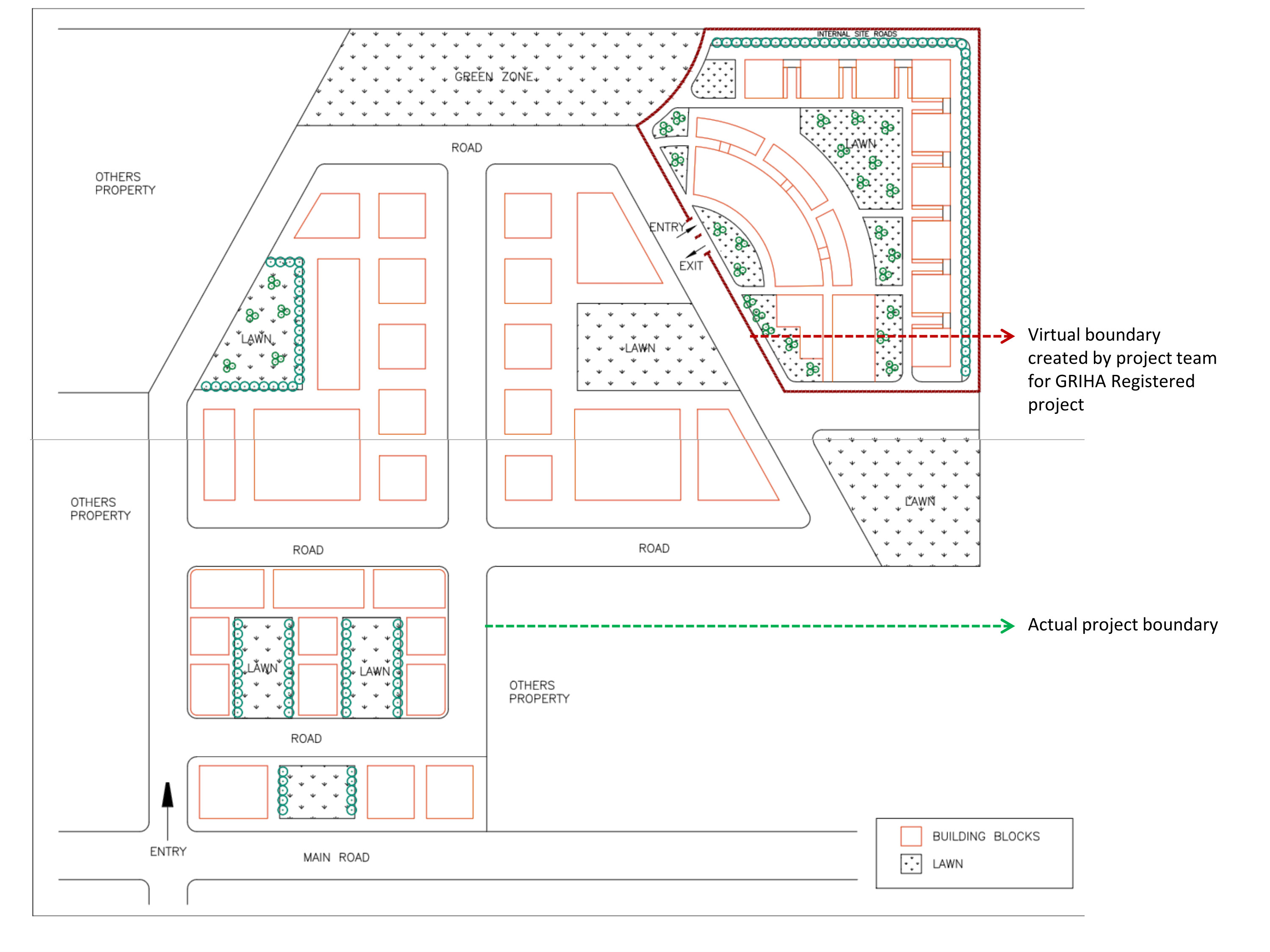
Eligibility & Virtual Boundary

Project Boundary
Virtual Boundary
Virtual Site Boundary 1 (1).jpg

REQUIRED CRITERION

All new construction projects with built-up area more than 2,500 sq.m are eligible for rating.

The following areas are excluded from the built-up area:

  • Parking area (Stilt/Basement)
  • Non-habitable basement spaces
  • Typical buildings: These are with same orientation, height, floor plan, plinth level and are constructed within a defined site boundary.
  • Service rooms: These are spaces that are dedicated to building services, such as electrical room, server room, meter room, etc., with no occupancy.

Rating Fees

Fee Summary

Total Built-Up AreaFees
BUA <= 5,000 sq.mINR 3,74,000
BUA > 5,000 sq.mINR 3,74,000 (for the first 5,000 sq.m) INR 9 per sq.m (over and above first 5,000 sq.m)

View Notes ↓ 

Calculate Your Project Fee

GRIHA Rating Process

Design Stage
Construction Stage
Post Completional/Operational Stage
Certification Stage
1

Registration

2

Orientation Workshop

3

Site Visit I

4

Site Visit II

5

Final Submission of Documentation for Phase I Criteria

6

Award of Points on Panel for Select Criteria

7

Documentation Submission for Remaining Criteria.

8

Preliminary Evaluation

9

Final Site Visit

10

Final Evaluation

11

Award of Final Rating

12

Reappeal

13

Document Submission for Reappealed Criteria.

14

Award of Revised Rating

GRIHA Rating Thresholds

Percentile Threshold
Achievable Star Rating
25-40
41-55
56-70
71-85
86 and more

Fast-Track Process

The fast-track process is intended to provide handholding support to projects that need a faster clearance for various business and government approvals. It reduces the time required for rating while maintaining the integrity and accuracy of the GRIHA rating system.

GRIHA Process – Normal vs Fast Track
Review StageNormal Review TimelineFast Track Review timeline
Review of First SubmissionWithin 30-45 working daysWithin 12-14 working days
Final Site VisitDone within 20-30 working days after sending review commentsWill be done within 5-7 working days after sending review
Due Diligence ReportSent within 15 working days after site visitWill be sent within 2 working days after site visit
Final ReportDone within 18-20 working days after receipt of second documentationWill be done within 5-7 working days after receipt of second documentation

Fast Track Fees: INR. 10 lakhs (Exclusive of GST). Register Now

View Notes  ↓ 

Register Now

Section Weightages

Grand Total
100 + 5
Points